How to Make Pine Resin Oil
This tutorial walks you through exactly how to infuse pine resin into oil, including resin-to-oil ratios, safety tips, and cleanup tricks. It’s a helpful read for anyone interested in natural skincare, herbal crafting, or foraged ingredients.
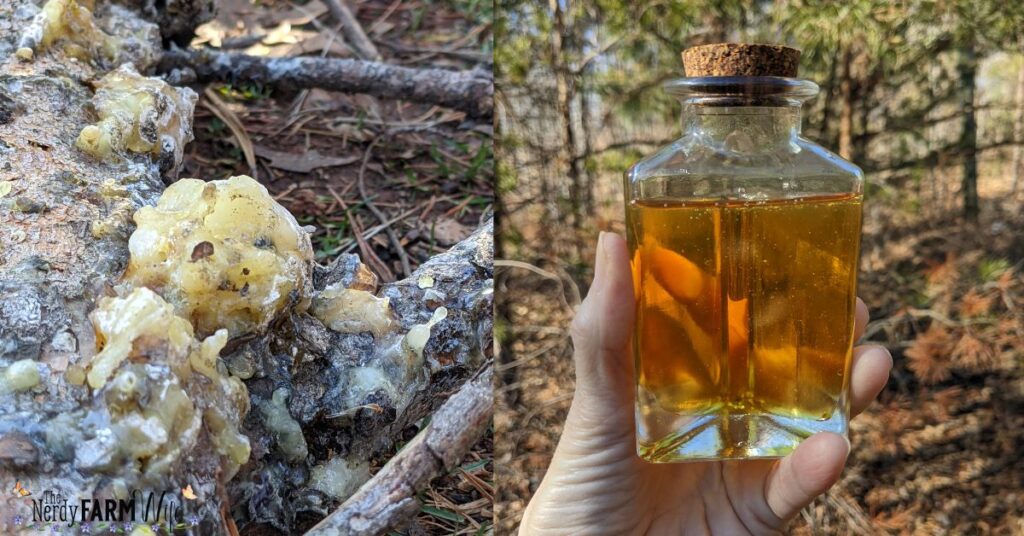
When working with pine resin, one common mistake is trying to melt the resin all by itself, then attempting to mix hot, melted resin directly into a soap or salve.
This approach can be messy and cause problems such as uneven results or recipe issues. An easier method is to first infuse the resin into oil, then strain to remove bits of bark and needles, and then used that infused oil in your formulations.
Below, I’ll walk you through exactly how to do that!
(Not able to forage your own pine resin? I’ve also purchased sustainably harvested pine resin from small businesses on Etsy before with great success. Look for RESIN, not ROSIN, as I explain in “How to Forage Pine Resin: What’s the Difference Between Resin and Rosin“.)
Preparing Pine Resin for Infusion
Before infusing, you’ll want to break larger chunks of pine resin into smaller pieces or powder. This increases surface area and helps the resin dissolve more completely into the oil.
How to Crush Pine Resin
You’ll need:
- large chunks of pine resin
- parchment paper or freezer paper
- a freezer
- a hammer
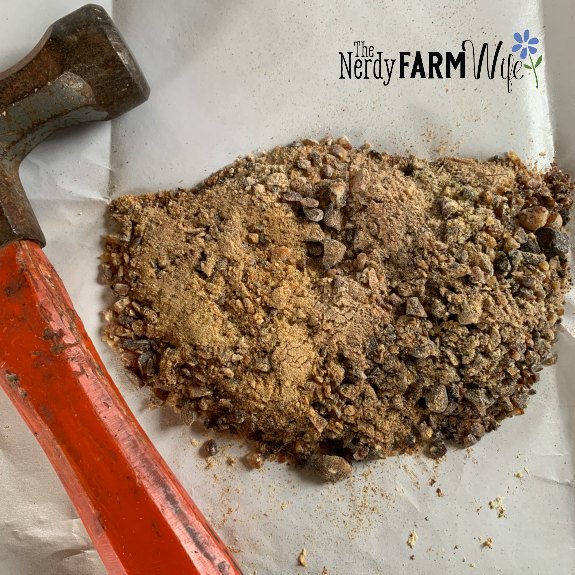
Place the resin on parchment or freezer paper, chunks of resin on a sheet of parchment or freezer paper and freeze it for several hours until hard.
Once frozen, fold the paper over the resin and carefully tap it with a hammer to break it into smaller bits. This step is best done outside on a porch or sidewalk, for easier cleanup.
While you could technically use a coffee grinder to make a finer texture – sticky things like resins and propolis will leave a residue inside your coffee grinder that is almost impossible to clean off, so I prefer using the hammer/parchment method in this case.
Pine Allergy Safety Note
If you’re allergic to pine pollen or pine nuts, use caution when working with pine resin or other pine products. Consult your healthcare provider if you have concerns or questions.
Why Infuse Pine Resin Into Oil?
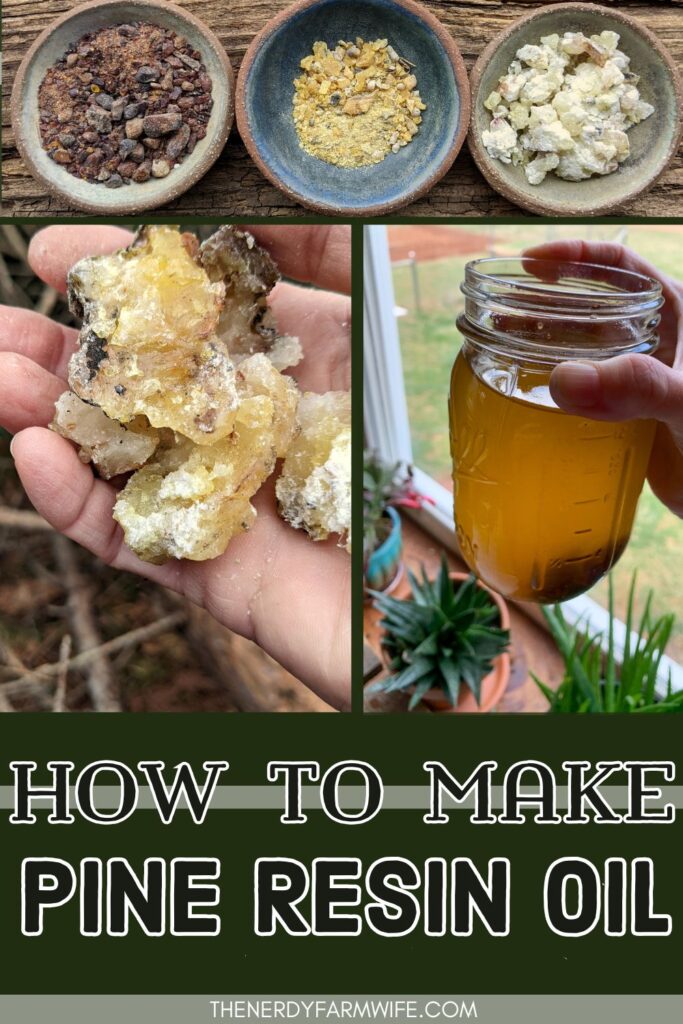
Pine resin is not water soluble, but it readily dissolves into oil or high proof alcohol. Infusing it into oil allows its antimicrobial, warming, and aromatic compounds to be captured in a form that’s easy to use in salves, soaps, and body care products.
Making the Infused Oil
Supplies You’ll Need
- crushed or powdered pine resin
- oil of your choice
- a glass mason or canning jar
- a small saucepan, (to make a double boiler setup)
- a stainless steel or heatproof strainer
- extra oil for cleanup (coconut oil works very well)
Simple Guidelines for Resin to Oil Ratios
The strength of your infusion depends on how much resin you use.
- For most skincare recipes: Use about 1 part resin to 3 to 4 parts oil. (Example: 1/4 cup resin infused into 3/4 to 1 cup of oil.)
- If you have a limited amount of resin: Use 1 part resin to 8 parts oil. (Example: 1 tablespoon resin to 1/2 cup of oil. There are 8 tablespoons in 1/2 cup of oil.)
- For soapmaking: Use 2 to 3 tablespoons resin for a pint jar of oil. (Which is about 1 1/2 to 1 3/4 cups of oil.)
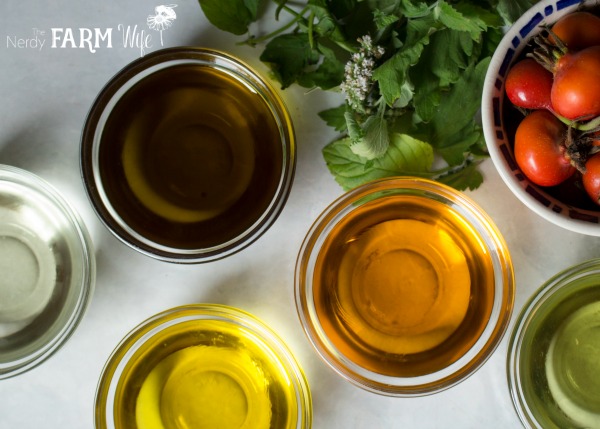
Choosing the Best Oil for Pine Resin Infusion
Here are some oil selections to consider, but feel free to use your favorite carrier oil.
- Olive oil – classic and reliable, this is the top choice for soapmaking and can also be used in salves
- Sunflower oil – a favorite of mine for salves because it’s gentle and good for sensitive and eczema prone skin types
- If you don’t want your salve, lotion bar, body butter, etc to feel too greasy, try mixing in or using fast absorbing oils such as rice bran, jojoba, and apricot kernel oil.
Important Pine Resin Safety Tip
Pine resin is flammable in its pure form. Always use indirect heat and never heat resin over a direct flame. A double boiler setup is essential.
Pine resin infused oil, salves, and skincare products are intended to be used externally (not internally), for sore muscles, minor wounds, dry or troubled skin, and as a drawing salve.
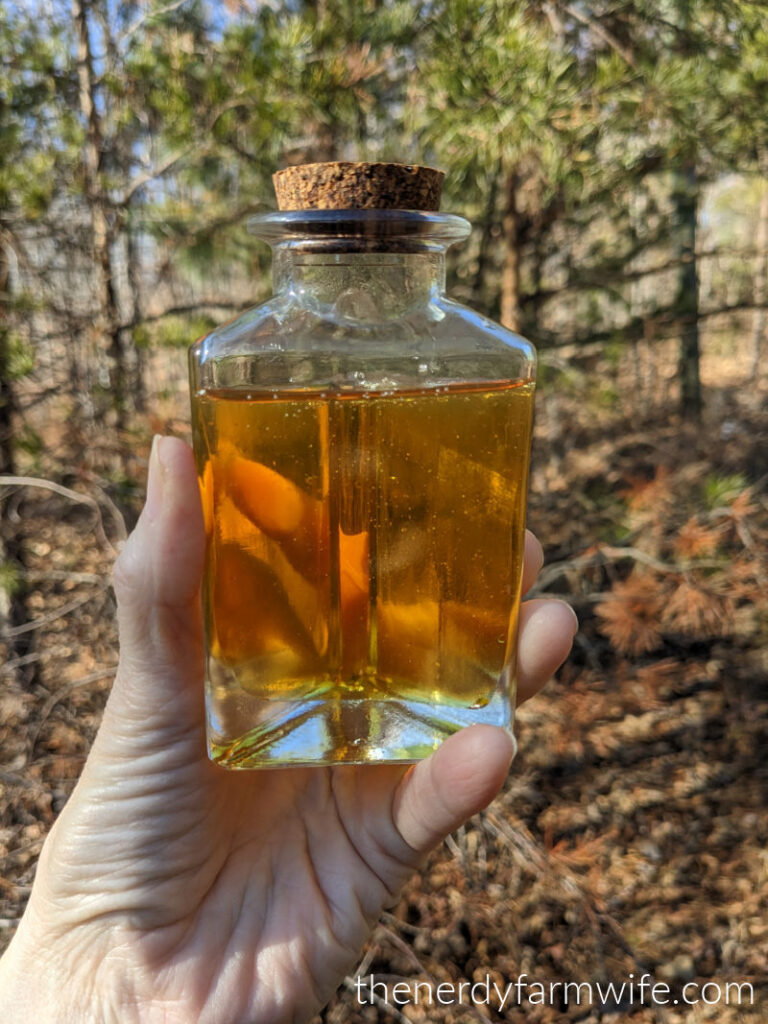
Step-by-Step Instructions: Infusing Pine Resin Oil
- Place the crushed resin in a heatproof mason/canning jar.
- Pour in your chosen oil and stir gently.
- Loosely cover the jar with the metal canning lid. (Don’t seal it, just lightly lay the top on.)
- Place the jar into a saucepan filled with several inches of water.
- You want the water to come up the sides of the jar, but not so much that the jar floats.
- Heat over medium-low for 2 to 4 hours.
- Stir occasionally, scraping the bottom of the jar to minimize clumping.
- Keep an eye on the water amount so it doesn’t evaporate completely.
- Once infused, strain the hot oil through a fine mesh stainless steel strainer into a clean jar.
- While they’re still warm, promptly wipe out the infusing jar, plus any tools you used, with a paper towel or rag, then wash with hot water and dish soap.
Shelf life: Infused oil usually has a shelf life of about 12 months, or as long as the oil doesn’t smell old or rancid. I’ve noticed that some strong pine resin oil infusions can have a wonderful fresh scent even two years after infusing, but it will depend on oil type used, how fresh the oil is, and how the oil is stored.
You may notice some sediment settled to the bottom of the jar over time. This is okay and normal. Just pour off the clear oil, leaving any sediment behind in the jar.
Read more about herbal infused oils:
How to Make Herb Infused Oils (+FAQS & Tips)
Jar Cleanup Tips
If resin stubbornly sticks to the bottom of your infusing jar, add more plain oil, then cap the jar and tuck in a warm area (like the top of your fridge) for a couple of months. Much of the resin should seep into the oil.
Another idea is to strain out as much oil as possible, then pour high proof vodka or alcohol into the jar, over the stuck resin. Cover and check on it every few days. The alcohol will eventually dissolve much of the resin, making the jar easier to clean.
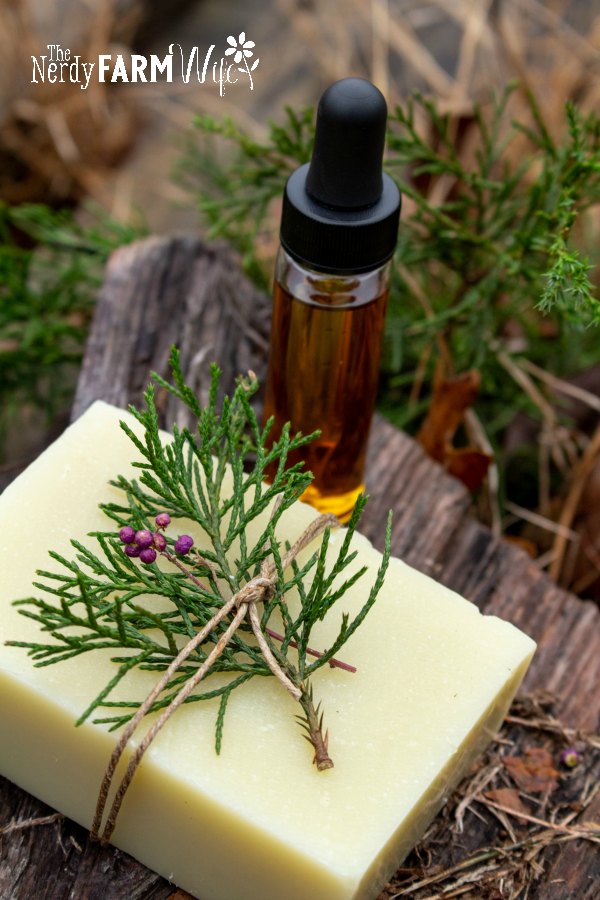
How to Use Pine Resin Infused Oil
Once your oil is ready, you can use it in:
- pine resin salves
- lip balms
- soaps
- body butters
- creams
- lotion bars
Simply replace part, or all, of the oil in a recipe with pine resin infused oil instead.
Example: If a body butter recipe calls for 2 ounces of oil, you could instead use 1 ounce of plain oil + 1 ounce of pine resin infused oil.
Ready to Use Recipes
Pine resin infused oil is the foundation for many herbal recipes. You may also find these related tutorials helpful:
- Foraging Pine Resin – How to identify, collect, and harvest pine resin responsibly.
- Pine Resin Infused Oil – (You’re here!)
- Pine Resin Salve Recipe – Turn infused oil into a healing or drawing salve.
- Pine Resin Soap – Use infused oil in handmade soap recipes.
References & Further Reading
De la Foret, Rosalee & Emily Han. Wild Remedies – How to Forage Healing Foods and Craft Your Own Herbal Medicine. 2020. Hay House.
Lopez-Alvarez, Oscar, et al. Resin tapping: A review of the main factors modulating pine resin yield. Industrial Crops and Products; Volume 202, 15 October 2023, 117105.
Park JY, et al. Abietic acid isolated from pine resin (Resina Pini) enhances angiogenesis in HUVECs and accelerates cutaneous wound healing in mice. J Ethnopharmacol. 2017 May 5;203:279-287. doi: 10.1016/j.jep.2017.03.055. Epub 2017 Apr 4. PMID: 28389357.
Rose, Kiva. The Forest in Winter; Mountain Rose Herbs Blog. Retrieved December, 2025.
Wood, Matthew. (2009). The Earthwise Herbal: A Complete Guide to New World Medicinal Plants. Berkeley, CA: North Atlantic Books.