
How to Make Your Own Lip Balm Recipes
A Complete Guide to Make Your Own Lip Balm Recipes – Learn about which oils, butters, herbs & essential oils to use to design your own custom lip balms from scratch!
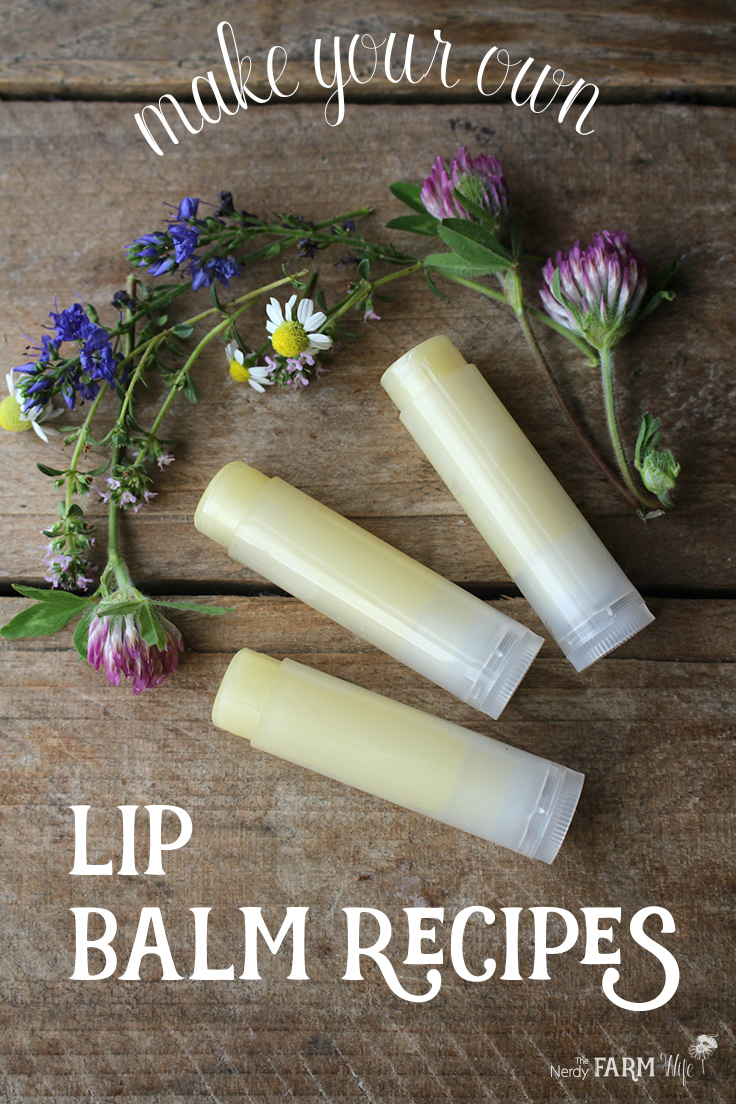
If you look closely at the homemade lip balm recipes that I’ve shared to date, you’ll note that they have similar ratios of oils, beeswax, etc.
Since I often get questions about making substitutions for one ingredient or another, I thought I’d share with you my basic formula that lets me (and now you!) create pretty much any type of lip balm desired.
I’m going to give you the formula, then suggestions on which oils, herbs, butters, etc to use, then share the link to a tutorial I made on creating your own labels.
Some links on this site are affiliate links. If you click on one and make a purchase, I earn a small commission for sending a customer their way. I only recommend products I’ve personally used & like.
Supply Sources
Oils, Butters & Beeswax: My go-to source for lip balm ingredients is Mountain Rose Herbs. They have high quality organic products that I’ve used for many years with 100% satisfaction. However, you may be able to find some of the ingredients you need locally as well, so check nearby health stores for oils & butters and your farmer’s market for beeswax.
Candelilla Wax for Vegan Option: You can buy that HERE at Bramble Berry.
Herbs & Flowers for Infusing: You may have some items growing in your own backyard, but if not, check Mountain Rose Herbs.
Lip Balm Tubes: You can find these in many online supply shops. I’ve personally ordered from places such as Bramble Berry and Bulk Apothecary and they’re all great. Look for accompanying shrink wraps if you’d like your finished lip balm to have a tamper proof seal. However, I prefer using stainless steel tins so there’s less plastic involved & they can be reused at home more easily.
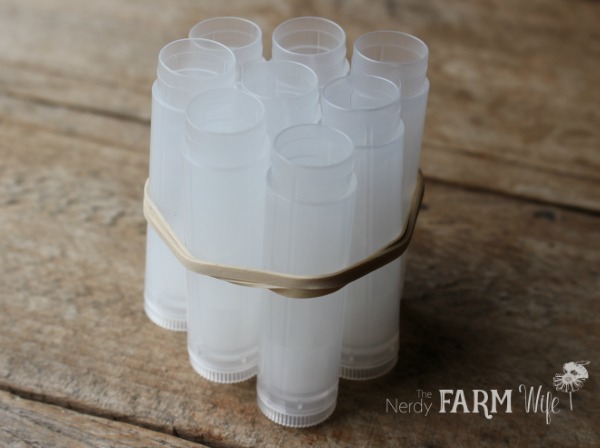
Lip Balm Filling Tray: Makes filling little tubes of lip balm SO much easier! You can buy one HERE. If you can’t get one though, try using a rubber band to group together several lip balm tubes at once. (See the photo above the Directions to Make section of this post for an example of what that looks like.)
Lip Balm Tins: If you’d rather use small round tins instead of plastic tubes, you can find those at Specialty Bottle or Mountain Rose Herbs. Check Bramble Berry for cute little slider tins.
Printable Lip Balm Labels: I’ve had the best luck with heavy-duty waterproof sheets from Rustic Escentuals. Don’t use regular sticker paper as it will peel right off of plastic tubes.
Heat Gun: A useful tool for smoothing the tops of your lip balms (and salves) and is needed if you plan on sealing your lip balm with shrink wrap. Look in your local craft store or check for heat guns at local craft stores or Amazon.
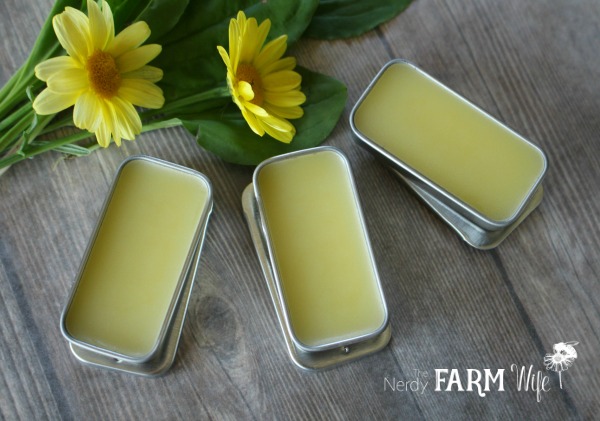
Basic Lip Balm Formula
This makes a recipe that works well in lip balm tubes. If you plan on putting your lip balm in tins, it needs to be a little softer, so try adding an additional part of carrier oil.
If your lip balm turns out too hard, melt it again and add more oil. If it turns out too soft, melt it again and add more beeswax. Keep melting and tinkering until it’s just right for your taste.
- 3 parts carrier oil (liquid oil)
- 1 part beeswax* (I tend to use a smidge more than this, but it depends on the recipe)
- 1 part solid butter (optional & adjustable)
- optional, essential oil (start with 1 to 2 drops per tablespoon or 1/2 ounce of ingredients, adjust as desired)
I usually make lip balms using tablespoon measurements.
So, plugging those into the formula above you’d need: 3 tablespoons carrier oil, 1 tablespoon beeswax, 1 tablespoon solid butter & start with 5 to 10 drops (possibly more or less) essential oil. This will make about 7 or 8 lip balm tubes.
(If making lip balm that will go in tins instead of tubes, try 4 tablespoons oil, 1 tablespoon beeswax, 1 tablespoon butter and 5 to 10 drops of essential oil.)
The basic lip balm formula converted to ounces would read something like: 1.5 ounces carrier oil, 0.5 ounce beeswax, 0.5 ounce solid butter and start with 5 to 10 drops essential oil.
Tip: One ingredient that I feel makes a lip balm is castor oil. It leaves such a soft glossy shine on the lips.
If at all possible, try to keep a small amount (about 1/2 tablespoon) in your recipe and I think you’ll be very happy with the results! It counts towards your carrier oil portion.
Vegan Option
For a vegan lip balm, use candelilla wax instead of beeswax. However, it can’t be exchanged in equal measures. The rule of thumb is:
Use approximately half as much candelilla wax as beeswax, when making recipe substitutions.
This means that the formula now becomes: 3 parts carrier oil, 1/2 part candelilla wax, 1 part solid butter and 1 to 2 drops of essential oil per tablespoon (or 1/2 ounce) of ingredients.
Translated to tablespoons, this equates to 3 tablespoons carrier oil, 1/2 tablespoon candelilla wax, 1 tablespoon solid butter and still start with 5 to 10 drops of essential oil and adjust as needed.
Directions to Make Your Own Lip Balm
Once you’ve designed your recipe, making it is as easy as 1-2-3!
Step 1
Using the Basic Lip Balm Formula above, decide upon your ingredients and gather everything together.
Step 2
Place your chosen liquid (carrier) oils, solid butter and beeswax (or candelilla wax) into a heatproof canning jar, pyrex measuring cup or empty tin can (for easiest cleanup).
Set the jar/can down into a saucepan filled with a couple inches of water to create a makeshift double boiler. Gently heat the pan over medium-low heat until everything melts together.
Step 3
Remove the jar/can from pan, wiping any water off of the outside so that it doesn’t drip into your lip balm while pouring.
Next, add essential oils, give the mixture a few stirs, then pour into lip balm tubes or small tins.
To make your life much easier, invest in a lip balm tube filling tray.
Finishing Up
Once cooled, cap and label. I usually use a heat gun to make sure the tops are nice and smooth.
Ingredient Choices to Make Your Own Lip Balm Recipes
Now, let’s go over some of the choices you have as far as ingredients.
Carrier Oils
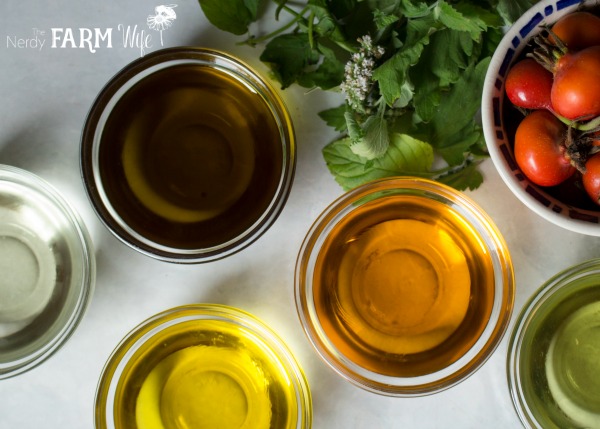
These are usually liquid, though I include coconut oil in here too since it melts upon contact with body heat. You can use any combination of these oils together.
Olive, sweet almond & sunflower oils make nice bases as does coconut oil, so I like to use a majority of those, then add a bit of extra rich oil like tamanu, pomegranate seed or jojoba.
Here’s a list of options to draw ideas from. I prefer organic whenever possible, since these are going right on your mouth:
- Olive Oil – an easy to find basic oil
- Sweet Almond Oil – softens lips
- Sunflower Oil – heals damaged skin
- Coconut Oil – melts easily (for those with coconut allergy though, it can make chapped lips worse)
- Tamanu Oil – heals many skin conditions
- Pomegranate Seed Oil – rich and nutritious
- Jojoba Oil – softens and nourishes skin
- Avocado Oil – rich and moisturizes dry lips
- Apricot Kernel Oil – for sensitive and mature skin
- Castor Oil – adds gloss and smoothness to lip balm
- Hemp Seed Oil – conditions lips
These oils can be infused with natural colorants or herbs in order to tint or enrich the benefits of your lip balm. (More on that below.)
Natural Colorants
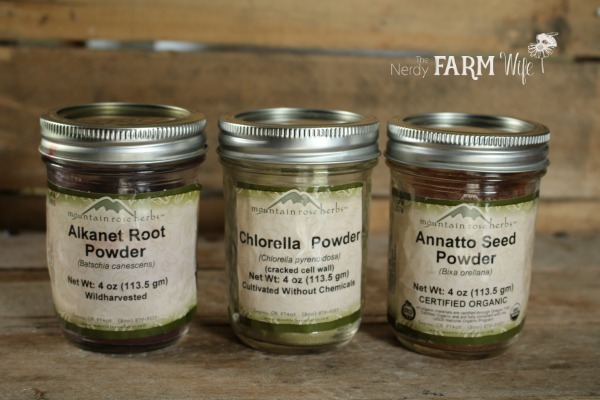
I use alkanet for a reddish or pink tint, annatto seed powder for an orangish tint and chrorella to lend a hint of green coloring for lime lip balm (none of these will stain your lips.)
Other plant based materials may work, but these are the ones I have personally tested and like. One-half to one tablespoon of colored infused oil is a good starting point to use; you can adjust to your liking as you go along in the recipe.
As a precaution, if you are pregnant or nursing, check with your doctor before using products containing alkanet root.
If you wish to add a chocolate flavor & color, you can use unsweetened cocoa powder or melt a small amount of baking chocolate and mix into your formula.
Colored clays don’t do as well in lip balm formulas because they can pull moisture from your lips and make them feel drier, so I don’t recommend using those.
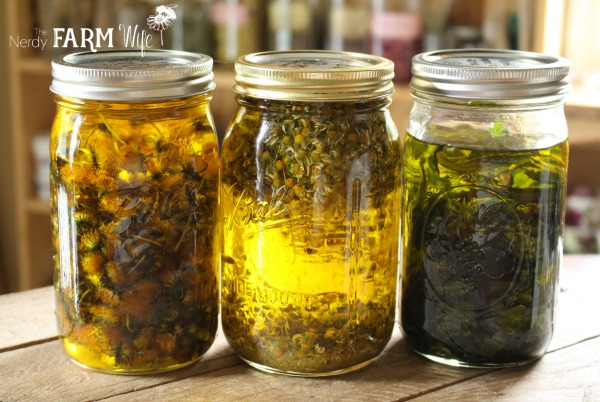
Favorite Herbs for Lip Balms
- Calendula – (soothing for almost anyone)
- Lemon Balm – (anti-viral, great for cold sores)
- Chamomile – (anti-inflammatory, soothing)
- Dandelion Flowers – (heals damaged skin)
- Plantain – (skin healing)
- Rose Petals – (skin soothing)
- Violet Leaves – (very helpful for chapped skin conditions.)
Any herbs I don’t buy or grow at home, I purchase from Mountain Rose Herbs.
Making Herbal Infused Oils
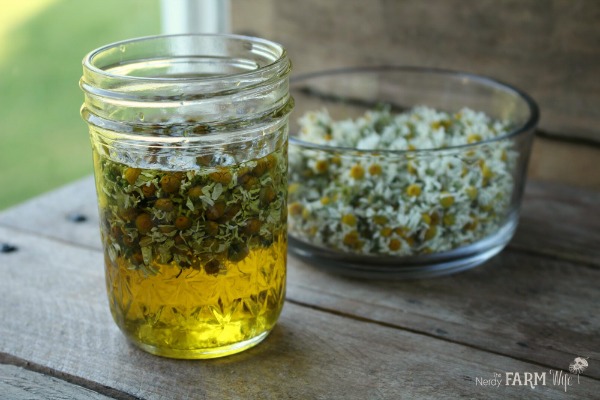
To make herbal lip balm, you’ll first need to make an herb-infused oil to go in it.
To do so, fill a small jar (I used THIS SIZE) about half-way up with dried herbs or flowers.
Cover with about twice as much as your favorite carrier oil, or to the top of the jar.
For a quick infusion:
Set the jar down into a small saucepan filled with a few inches of water. Heat over a low burner for a few hours, keeping a close eye that the water doesn’t evaporate out.
Remove from heat and strain.
For a slower, more traditional infusion:
Cap the jar of herbs/flowers and oil and tuck it away in a cabinet for around 4 weeks, shaking occasionally as you remember to. When the infusing time has passed, strain.
For a third option:
You could also set the jar of herbs/flowers and oil in a sunny windowsill for several days to a week to jump start the infusion. (Don’t store for long periods in sunlight though, as it tends to fade flowers and herbs over time.)
Honey in Lip Balm
Many people love the thought of honey in their lip balm, and I’ve made some with it as an ingredient before, but frankly it’s not the ideal addition because as a water based product, it will tend to separate out of the oils.
If you add any to your recipe, use a small amount, stir very well and realize that much of it will settle to the bottom of your measuring cup. Don’t try to incorporate this extra in, just discard it.
Solid Butters
Solid Butters are those that are solid at room temperature. These are optional, you can leave them completely out, but they do add a nice creaminess to your lip balm formula.
Mango and shea butters can usually be added or subtracted without much effect to the end product. Cocoa and kokum butters are harder though, so if you include those in your formula, notch up the amount of carrier oil a bit to compensate.
There’s a subset of the population that reacts to cocoa butter with further dryness and chapped skin, so if you’re lips stay constantly chapped while using a cocoa butter formula, suspect that as a potential culprit. (Coconut oil acts similarly to those who are sensitive.)
- Shea Butter
- Mango Butter
- Cocoa Butter
- Kokum Butter
Essential Oils for Scent & Flavor
Cold-pressed citrus-based essential oils (like lemon, grapefruit & bergamot) are photoxic, which means they can make your skin more sensitive to sun, so you should take care when adding those to lip balm.
Not all are though, so don’t feel that you have to completely exclude yourself from enjoying citrus flavored lip balms during daytime hours. If they’ve been distilled, they’re usually safe to use. (Double check with the manufacturer to see what type they carry and what their recommendation is.)
The following essential oils can usually be safely used in your lip balm formula:
- Peppermint
- Spearmint
- Orange (Sweet)
- Lime (distilled, not cold-pressed)
- Lemon (distilled, not cold-pressed)
- Mandarin
- Tangerine
- Vanilla Absolute
- Clove (use sparingly as in one or two drops per recipe max – it’s very warming)
- Camphor (use sparingly in short-term formulas intended for cold sores, 1 to 2 drops, adults only)
- Tea Tree Oil (anti-bacterial, anti-viral, can overpower the scent of your lip balm so use sparingly and only in adult short-term cold sore recipes)
I’ve also seen Lavender & Rose essential oils in some formulations and although I appreciate the smells in other items, am not fond of either on my lips. But, my way is most definitely not the only way and if you want floral lip balm, then have at it! Remember, this is your creation!
Extras
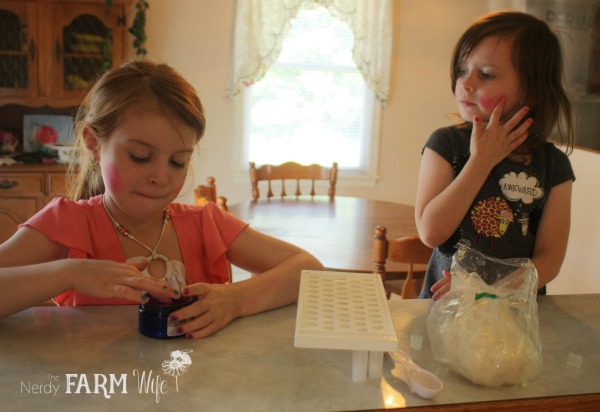
When my daughter & nieces are inventing lip balm recipes, they always like to add a bit of lip safe mica for some shimmer and shine. I buy those from Bramble Berry.
Some people feel that mica products are unhealthy additions to cosmetics, while others do not, so they’re definitely optional.
Personally, I don’t normally use them in my products since I enjoy using natural colorants and botanicals much more, but they’re fun for special occasions such as cousin playdays or sleepovers! :)
Lip Balm Recipe Examples (Using the Formula)
Peppermint Ice Lip Balm
- 2 Tablespoons Avocado Oil
- 1/2 Tablespoon Jojoba Oil
- 1/2 Tablespoon Castor Oil
- 1 Tablespoon Beeswax Pastilles
- 1 Tablespoon Mango Butter
- 16 drops of Peppermint Oil (it’s very minty & cooling on the lips with this amount)
Vegan Spearmint Lip Balm
- 1 Tablespoon Sweet Almond Oil
- 1 Tablespoon Chlorella Infused Olive Oil (for color)
- 1/2 Tablespoon Jojoba Oil
- 1/2 Tablespoon Castor Oil
- 1/2 Tablespoon Candelilla Wax
- 1 Tablespoon Shea Butter
- around 10 drops of spearmint essential oil
Other Lip Balm Recipes
These are some lip balm recipes that I’ve shared on this site.
- Coconut Mango Lip Balm
- Peppermint Elderberry Lip Balm
- Cold Sore Lip Balm
- Peppermint Rose Lip Balm
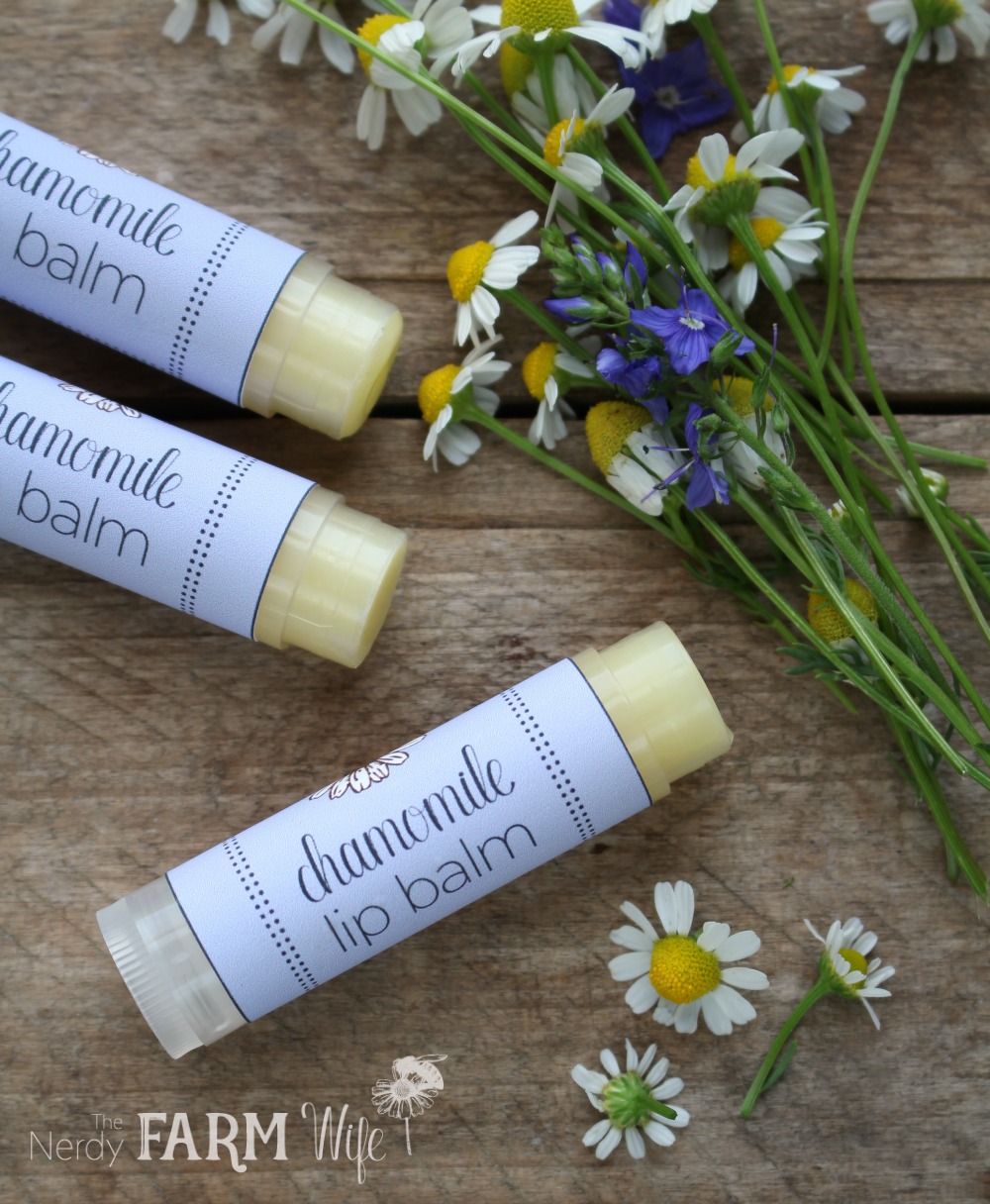
- Chamomile Lip Balm with Printable Labels

Don’t forget hemp oil – my fav for lip balms! So good for the skin and adds a nice green color!
Great post – so much good info!
Oh yes, hemp oil! Thanks for the reminder! :) I’ll add it in this afternoon! Glad you found the post helpful!
Trying to ask a question, what would make it feel gritty? Also used 2 tsp of candelila instead of the 1T beeswax for the spearmint recipe and still way too soft. Any tips? Thanks.
Hi Deborah! Grittiness is usually from shea or mango butter. Here’s a great article on fixing that:
https://bettersheabutter.com/grainy-shea-butter-heres-fix/
If the lip balm with candelilla is too soft, then try melting it down and adding another teaspoon or two of wax. Are you pressing the wax into the spoon to measure or just lightly piling it in? If lightly piling it in, you’re probably not getting enough wax. You can melt it several times if needed to get the right ratio of wax to oils, just keep track in your notes so you know the right amount to start with next time you make the recipe. :)
Thank you so much for sharing! I rendered the wax from my beehives this year and have been playing around with body butters and lip balms, which I barter or sell. The body butter turned out great but my lip balm is way too stiff. I will play around with your recipe next year when I harvest new wax.
Hi Tracy! I find a lot of recipes are too stiff for my tastes too. I hope you have fun playing around and find the perfect lip balm for you. :)
This is so awesome! So helpful! I love the lip balm filling tray too. It has been a while since I have made lip balm and now you have me inspired again!!
That’s great Angela! :) I LOVE the lip balm filling tray too. Before I discovered they existed, I had the dickens of a time trying to fill those little tubes without knocking them over!
I’ll try this soon. Just a suggestion that I take from cooking and would apply here. Invest in a digital scale that measures in grams. Working off of exact weight ratios improves consistency whether you are making a small batch or a large batch.
Thanks Gabe, you are correct – a digital scale is a great investment for those than can afford one. :)
Hi, I’ve been getting into makeing things myself latly and used this to make my first ever batch of lip balm and it turned out great. The ingredients I used were a bit boring so next time ill play around with more essential oils and some natural dyes. Thanks so much for the helpful post, it gives you so much freedom to play around!
Hi Lucy, I’m glad your lip balm turned out great! Have fun creating! :)
Hi,
I love your website. I know I’m a guy but i’m addicted to making my own lip balms. I’m actually starting to make it maybe a business but sadly in my country a guy who makes lip balms it’s not so good lol. But i will give it a try.
Anyway, i got some of the books that you recommended and I tried some of your lip balm recipes. Great stuff.
thank you so much for your knowledge.
Christophe
Hi Christophe! I’m so glad you enjoyed the recipes. Good luck with your business – I think it’s a great idea and I hope it’s very successful for you! :)
Jan, do you have a natural colorant for purple? Or a blue to mix with alkanet? Violet petals?
Hi Janet!
I’ve been pondering this very thing – I want to make my mom a pale purple tinted cream for mother’s day and was wondering how to do so.
I’ve seen that beet root can lend a purplish shade of red, so have some on my list of herbs to order this weekend to experiment with.
I was also tempted to get some lavender mica to tint it. But, one of the ingredients had the name cyanide in it and when I looked it up – I just don’t feel comfortable using it.
Sooo… finding a natural purple is on my list of things to try to figure out. I’ll be sure to let you know if I find a solution!!
Jan, another source said that alkanet yielded a deep purple to blue but you only mention reddish or pink tint. So has deep purple not been your experience with askant? How about a lavender infused oil? Does that cast a purplish?
Just learnin’ Thanks for your generous sharing.
With alkanet, I get a pink to red, depending on how concentrated it is. Here’s a photo of a lip balm I made using it to get red:
https://www.etsy.com/transaction/106833493?
I also used in in my rose cream to get pink:
https://www.etsy.com/transaction/104281984?
(those recipes are both on this site if you want to see more details on them)
However, in soap, alkanet turns purple, because of the high alkalinity. I have a batch of violet blossom soap curing now that I tried to turn purple. It’s slightly gray tinged at the moment, but lightening as it dries. Hopefully, it will end up more purple! :)
Lavender infused oil ends up pretty much the same color as the oil started just with a bit of a browner tinge. Sadly, the color doesn’t hold.
I did think of a few things I used in the way past to color foods that I might try as well in my cream:
blueberries, blackberries, red cabbage leaves
I think I’ll try blueberries first in my water infusion for the cream. I’m not sure how they will do infusing in oil for lip balm though, without at least drying them first to get rid of the water content.
I’m learning along with you on this quest for a natural purple! So ask any questions or share any brainstorms you come up with! :)
Hi Jan,
I have a suggestion about trying to find a purple tint. When I was younger, I used to play around with hollyhocks and experimented with seeing how dark I could get a glass of water to turn when a hollyhock was steeped in it. I found that dark red and magenta hollyhocks turned the water a deep purple. Since you are very familiar with hollyhocks, it might be worth a try infusing them into a carrier oil. Thanks for all your work!
J
Hi J, Thanks for the wonderful idea! I believe my mother has some dark red hollyhocks at her house – I will check with her and try it out! Thanks for sharing! :)
I bet if you use the essential oil Chamomile Blue you will definitely get a blue tint. But it is a strong smelling oil so use a small amount. You can mix another EO oil to create a unique scent.
Hi Lorri, That’s a great idea; blue chamomile is truly lovely stuff! If you use white colored wax (instead of yellow beeswax) then it might help the tendency it has of turning greenish. I like the idea of mixing it with another essential oil too. :)
I am not in any way affiliated with them, but I just found some blueberry butter on the Mystic Mountain Sage site that might work to tint your product purple. I don’t know how much you’d need to use. At least you know that blueberries would work to add a purple tinge. They’re my favorite fruit, so I’ve been thinking about buying some of the butter for my own projects.
I’m so glad I found your site! I was doing a search to see if tamanu oil would be good for my next batch of lip balm. I have a recipe I’ve been tweaking, but I may test yours out at some point too. Thanks for sharing your expertise!
Hi Katie, Thanks for the information! I remember reading something a few years ago about blueberry butter, but had forgotten completely about it so I’m glad you mentioned it. :) It sounds like a lovely product to experiment with! Thanks for the great idea and have fun tweaking your recipe!!
Thanks for all the helpful info! I can’t wait to make my first batch. I’m going to be including kukui nut oil in with my carrier oils; it has awesome benefits for chapped skin. The nut has been used by the natives in Hawaii for hundreds of years for various skin issues. I think it will make a great addition for the summer months :) Thanks also for posting about the citrus EO’s. I thought all citrus EO’s where phototoxic so it’s good to know that not all of them are. My only question is, you said lime EO is safe to use only when distilled. How do you know if it’s been distilled?
Sounds like it will be a great batch of lip balm! :)
I buy my essential oils through Mountain Rose Herbs and they clearly label them. Most good sources should do the same. Here’s the info Mt Rose has:
“All of the essential oils offered by Mountain Rose Herbs are obtained by steam distillation of whole plant material with two exceptions:
Absolutes/Resins- are extracted with a solvent, usually alcohol and sometimes other hydrocarbons, such as benzene, hexane, etc. While they are not suitable for therapeutic aromatherapy, they do make wonderful perfumes and are alcohol soluble. Those oils which we have found to be extracted with solvents will be noted as “solvent extracted.”
Citrus Oils- All citrus oils offered are distilled strictly through cold pressed methods, and no steam distillation was employed to produce these oils.”
I will note that while cold pressed lime oil is listed as photo toxic, for personal use and for my extended family – we use it just fine (including a few fair skinned red-heads.) Of course, we’re not sitting out in the beach wearing it, but day to day use of being indoors with intermittent periods of outdoors, has had no adverse reactions. However, it’s always recommended to keep in mind what the experts say, especially if you’re sun sensitive. :)
where to buy beeswax in indonesia?
how if we use candelila oil instead of beeswax?
thanks
Hi J, I’m not sure how to buy beeswax in Indonesia, but if you don’t have beeswax available, you can substitute candelilla wax instead. Don’t exchange it equally though, use half as much candelilla wax as beeswax, when making recipe substitutions.
Thank you for these ideas. I recently tried to make a beeswax lip balm using 3:1 olive oil and beeswax but it is very glossy and I prefer more of a matte look. Do you have any idea what I could do differently to get this? Maybe a different oil?
Hi Jessica! Did you add a butter to your recipe, such as: shea, mango or cocoa butter? That *may* help break up the gloss a bit. You can also try melting your lip balm and adding more beeswax so that the oil ratio is lower, but it will still probably have some shine. This link on making matte lipsticks might give you a few helpful ideas as well:
http://www.soapqueen.com/bath-and-body-tutorials/lip-products/lipstick-recipes-2/
Hello,
I have been searching the web with no success. I want to make lip balms for gifts this holiday season and would love to try making Earl Grey tea lip balm. How might I infuse the tea into my mix? Just make it like I am making tea and add a small amount?
Thank You
Hi Becky!
You can infuse your oil with a variety of herbs and teas and I feel that Earl Grey tea should work just as well. Just infuse your oil with the dried tea (don’t add water to it first – you don’t want ANY water in your lip balm; it will just bead out and make a mess.) Here is a post I wrote on using dried rose petals to make lip balm – just do the same infusing technique with your tea, instead of the petals:
https://thenerdyfarmwife.com/peppermint-rose-lip-balm/
Once the oil is infused & scented to your satisfaction, strain out your tea and use in your lip balm recipe. One thing to keep in mind is that bergamot essential oil can cause sensitivity to sunlight which can lead to red skin or sunburn, but I *think* the amount of bergamot in the tea should be very minimal and not concentrated as it is in an essential oil. Just in case, you could use something like mango butter (which has some slight UV protecting qualities to it) in your recipe and do a test run on yourself while you’re wearing it outdoors. I’m fairly certain it shouldn’t cause problems, but thought I’d mention it as a potential precaution to keep in mind.
I think that sounds like a wonderful & unique gift idea and I hope you have a lot of success with your experiments! :)
Great recipe. I really want to try it. i have all the other things except for the beeswax. I will see if I can get it anywhere.
Thanks for sharing this wonderful idea!!
:)
Glad you liked it! :)
Hi Jan,
I really enjoy your posts and am excited to try making some lip balm. Lately I’ve been looking at making my own products for beauty and cleaning. My creative and DIY obsession is always close by. I was wondering how many jars does your recipe fill? I was considering buying some 3ml jars and would like to know approximately how many I would need. Also I read that not all essential oils are safe for pregnant women. Which ones would be safe?
Thank you so much for sharing your recipes and ideas.
Hi Linda, Sounds like you have lots of fun projects ahead! :)
3 ml is roughly a tenth of an ounce (.10 oz), so depending on your ingredients and how large you make the batch, would depend on how many it would fill. I believe that the sample recipes I posted filled from 7 to 9 lip balm tubes, which are .15 ounces each.
The recipe is given in parts so you can do something like 3 ounces oil instead of 3 tablespoons total oil, etc. and you can add up the amount of ounces in your end recipe to get an estimated total that way too.
As far as essential oils, there is a pretty short list of the ones safe for pregnancy. You would want to pick the one that you are interested in and then look it up and see if it specifically says: not for pregnant women. For example, if you click the link above for Peppermint Oil, it will take you to the page on Mountain Rose Herbs where it says: “Avoid in epilepsy and while pregnant. May cause skin irritation. Avoid with homeopathics.” You’ll find that the options are pretty limited and you might want to stick with unflavored or thoroughly research the ins and outs of each oil before using. To be 100% sure of safety in use for your own situation, ask your doctor or naturopath though, since the internet often contains conflicting information.
Have fun making goodies! :)
Thank you a hundred times for this post, along with how to make labels for homemade lip balms. I have been collecting tidbits of info from here and there, but it is fantastic that you presented it so thoroughly all in one place. I cannot wait to start making my own, thanks to you!!
I’m so glad that you found it all helpful! Have fun creating! :)
Would you be able to use your favorite tea in the lip balm that is not an oil ?
Hi Alexis! You could use your favorite dry tea blend to infuse oil and then use it in lip balm, but you can’t add anything water based without it separating/oozing out.
Thanks for providing the ratios! When you say that you can leave the butter out – should I replace that portion with a carrier oil? Or simply not include it? Thanks in advance!
Hi Emily! You can completely leave the butter out, if you’d like. Since it’s a more solid-at-room-temperature substance, if you replace it with more carrier oil, your balm would get too soft. If you do leave it out and find the consistency of the final product too soft or too hard, you can just remelt it and add a bit more oil (to soften) or a bit more beeswax (to firm) until you get exactly what you’re looking for. :)
This all looks so fantastic, I can’t wait to try!
Have you ever put your balms in small jars instead of a tube? (I prefer to apply gently with my finger.) If you have tried this method, have you adjusted the recipe? I would imagine one might want a creamier, less solid balm.
Thank you so much!
Yes, absolutely! When I do that, I ease up on the beeswax and add a bit more oil until I get the consistency I like. I need to go in and update this tutorial soon and I’ll gather together a few concrete ratios and add them to the post. Thanks for the reminder! :)
Hi Jan! I commented in December and asked about adding both beeswax and candelilla wax to make lip balms. Thank you for your help! The lip balms made great Christmas presents and everyone was pleasantly surprised. (: I am excited to continue to make more lip balms. I’ll be trying your label tutorial as well. Thank you again!
That is wonderful to hear! I’m so happy they turned out well and everyone loved them. :) Have fun making more lip balms!
Thank you for sharing! Im gojng to try to do the lip balm right now and will try to give it a purple hint with eco purple maiz (corn) powder thst i got in my local heath shop. Its a powdered drink and im hoping it works….what do u think?
Sorry! The purple powder doesnt give it a purple colour at all!!! But the balm still looks great. Hardening now. Cant wait to try it. Thx again!
Hi Shakira,
That was a great idea you had – thanks for sharing how it worked out!
I’m glad you liked the recipe! :)
Hi Jan, thanks for the knowledge! I’m excited to work those recipe :D But I wonder, how long will the lip balm be able to be used before it expire? Do you know about it? Because you haven’t mentioned it in you post
Hi Aurelia! Lip balm is usually fresh for at least 6 to 9 months, or even longer. (I have some that’s much much older but still in great shape.) You can add vitamin E to help prevent the oils from going rancid as quickly as they might otherwise. Exposure to high heat and direct sunlight (i.e. storing in your car) will lead to a much shorter shelf life. I hope that helps! :)
Great! That’s what I was looking for. Thank you very much, Jan :D
Thank you for sharing these recipes. It was especially helpful to have the measurements in both tablespoons and ounces. I also appreciate that you provided advice on vegan versions. Thank you! I used avocado oil, cocoa butter and candelilla wax. The final product is a little soft. I prefer a more solid lip balm? What adjustments do you advise? Also, I added grapefruit essential oil. I didn’t notice much of a fragrance after 10 drops so I added more like 15 drops. My lips feel somewhat dry a few minutes after applying the balm. Did I do something wrong? Do you think adding so much essential oil could actually dry my lips? Thanks for your help!
Hi Sara!
If you want a more solid lip balm, you can remelt it and add a pinch more wax. Before you pour the remelted mixture again, keep it warm and test a small bit by dipping a frozen spoon into it. That helps you see if it’s the right consistency before you pour any more.
Grapefruit essential oil isn’t recommended for lip balm because it’s phototoxic (which means it can make you much more susceptible to sunburn.) If you scroll down the post, there’s a list of ones that are usually safe to use. Citrus oils are pretty potent (as evidenced by how well they act as cleansers), so I think it sounds like it’s just too strong for the skin on your lips.
If you normally use cocoa butter just fine, this won’t apply – but a small subset of the population has a sensitivity to cocoa balm that usually manifests itself as red, peeling, and/or dry skin. So, they keep applying more, trying to help the symptoms, but they’re actually making the problem worse. For those people, cocoa butter on sensitive skin tissue can be problematic.
Finally, if you add a bit of castor oil in your recipe, it will give a nice finish to your product so that it smoothly glides over your lips instead of dragging.
I hope one or more of those ideas help!
how do I make my lip balm harder
can you help please
Hi Helena, To make lip balm harder, remelt what you made and add a bit more wax to it. The wax is the portion that hardens the lip balm, the oils make it softer.
What a great bunch of info! I make my own bath and body products and will be adding lip balm to them once I get the tubes in. Just FYI depending on how many you’re buying at a time SKS Bottle & Packaging may be cheaper. Their smallest bag (24) is .31 each but their larger bag (144) is only .13 each compared to the site you mentioned being .16 each. Plus they have every kind of packaging you can imagine!
Thanks for the tip Stacy, I’ll be sure to check them out!
I love this lip balm recipe! I have made a few different lip balms with much success, but found that after a few months, sometimes sooner, the balm “texturizes.” I can’t describe it any other way. The one I made with tangerine essential oil did it in less than 6 weeks. What is causing this, and how I do I control for that next time? I use a mix of beeswax, jojoba, castor, vitamin E, Shea and essential oil. I have used coconut oil, and it made the creamiest balm ever, and that one seems to have stayed smooth the longest.
Hi Kristen! Whenever a weird texture shows up in lip balm, the first suspect is shea (or mango or cocoa) butter. If butters get too hot in their lifetime – during storage or shipping or sitting in a mail box for hours on a hot summer day, or held on the heat too long when melting with beeswax, they can form crystals that feel grainy on your lips. To try to keep this from happening, as soon as your shea butter melts, remove it from the heat. Pour your lip balm mixture into the tubes right away. Cooling them quickly, by placing in your fridge might help too. Try to avoid temperature fluctuations (i.e. don’t store lip balm in your car and carry around in your pocket for hours at a time.) I hope one of those ideas help!
I notice there is refined and unrefined shea butter. Which of the two am I looking for as an ingredient?
Hi Mary! I usually use refined shea butter since it’s unscented. Some batches of unrefined shea can smell strong unless you put a lot of essential oils in to mask the scent, which isn’t ideal in lip balm. However, many people like using unrefined shea, so it’s probably a personal preference thing.
great info, thanks very much for the post!
Glad it was helpful!
Hi.. which oils do you normally use for infusing natural colorants?
Hi Mansi! I usually like sunflower oil or light olive oil for infusing natural colorants.
Just wondering have you ever made a vanilla flavored lip balm and how would you do it?
Hi Lisa! You can buy vanilla absolute oil that will help give a little natural vanilla scent to your lip balm. (You can also buy vanilla lip balm flavor from places like BrambleBerry.com. It’s not considered “natural” though.) I’ve tried before to infuse a plain oil with vanilla beans, but unless you use a ton of vanilla beans, infuse for a long time, then double infuse that oil again, you still won’t get as strong a vanilla scent as the absolute oil. (Which you can buy at mountainroseherbs.com.)
Also how much vitamin e would you add to help it not go rancid?
I use just a drop or two in a batch of lip balm.
This recipe is amazing! I was looking for something that used Castor Oil because I put that on my lips all the time. This came out perfect! ( I made just a tiny bit but kept the ratios the same). Thank you! You’ve made my 3rd blizzard here in Boston a little better!
I’m so glad you like it! Stay warm and safe in all that snow!
I made my first lip balm over the weekend and it’s not holding it’s form. Hardened nicely, but the next day it’s like it’s melting; should I add more beeswax to my formula?Thanks so much for this breakdown it was awesome.
Hi Tara! Yes, you sure can remelt it and add more beeswax. Sometimes, I have to do that a couple of times, to get just the right texture I’m going for with a recipe. I’m glad you found the post useful! :)
Will give that a try. I’m actually going to use some of your tips added to my original recipe and make another batch this evening. Thanks again!
Happy to help! :)
Hi Jan! You did a beautiful job explaining everything, I’m so happy I found your site! Thank you for sharing so many excellent ideas and examples, it really helped me understand the basics behind a great lip balm recipe. I’m excited to try my own version! I especially love the fact that you made sure to mention that the lip balm can remedied if it doesn’t turn out quite the way you like it- I had no idea you could melt it again after it hardens! The links and information you shared is, by far, the most helpful DIY site I’ve come across for lip balms. I’ll let you know what I tried for my first batch, if I had to make any changes and how it turns out! I look forward to reading more of your “how to’s”! So excited!! :)
Hi Amber, I’m so happy that you found the site helpful! I hope you enjoy making your lip balms! :)
Hi Kelly! I’m going to Uganda in June and plan on making and taking about 100 lip balms with me as gifts for the woman in the village I’m visiting. I have my supplies ordered but I have 2 questions,1. Where can I order the balm holder tray 2.how do you think they will hold up during that long of travel? Thanks for any suggestions and I love your website!
Hi Lisa! I got mine at Rustic Escentuals, but I recently saw one on Bramble Berry too: http://www.brambleberry.com/Lip-Balm-Pouring-Tray-P3223.aspx
That is really nice to bring lip balms as a gift! I’m not sure how they’ll hold up during travel, but you might want to add a touch more beeswax to make sure they don’t melt — OR — possibly a better idea (and I’m just thinking out loud here) use part beeswax and part candelilla wax since it has a higher melting point. Just a theory though. I hope you have a wonderful trip!
I’m sorry, I addressed you Kelly by accident
No problem! :)
Jan-
I made some lip balm with coconut oil and banana extract. But, when I carry it in my purse, it melts! I don’t have enough money to buy beeswax, though. Any suggestions?
Thanks!
Jaik
Hi Jaik! Do you happen to have any cocoa butter? You might be able to melt enough of that or some other really solid butter with the oil and have it be firm enough. You could also make your lip balm into a lip gloss – do you have an old lip gloss tube or roll on bottle you could clean out and put it in? Or even a small tin or container that can seal tightly, then you can rub it on with your fingers. That’s all I can think of right now, but if I come up with any more ideas, I’ll leave them here as well. I hope you find a good solution!
Hi Jan, this is the most helpful site I’ve found so far. Thank you!! My search was inspired by a year of recurrent cold sores. I’ve used Valtrex, Lysine, Lemon balm extract, licorice root extract, orajel, tea tree oil, and abreva….and still got a lot of cold sores. So now I’m exploring prevention. I’m wondering what you think of this recipe: 2tbsp calendula infused olive oil, 1 tbsp coconut oil, 1 tbsp jojoba, 1 tbsp Shea butter, 2tbsp beeswax, 2 drops vitamin E, 15 drops lemon balm extract (since I don’t have infused oil), 10 drops tea tree oil, 10 drops licorice root extract into tubes. Does that sound realistic? And if it’s too melty is there a trick to removing and remellting to add the extra beeswax? Thanks again for sharing your insights. I’m feeling hopeful about preventing my cold sores. ?, Marta
Hi Marta! That sounds like a great recipe, as long as those extracts are oil based. (If water based, they’ll just separate from the other oils and wax.) You can definitely melt down lip balm and add more oil, to soften it, or more wax, to firm it up – lip balm is super flexible to make! :) Good luck preventing your cold sores!
Hi. Any ideas on doig earl grey? I had some savannah bee company earl grey Chapstick we all fell in love with and I want to make my own. Any ideas?
Hi Cleo! If you scroll up a little ways to this comment: https://thenerdyfarmwife.com/how-to-create-custom-lip-balms/#comment-3679 someone else had that great idea too. I didn’t hear any feedback as to how it worked, and never got around to trying it myself (though I want to still, since it sounds fantastic.) Good luck if you test it out!
Thank you so much for all of the wonderful recipes and pointers! I have also been using Mountain Rose Herbs and Specialty Bottle for years and love their products. I will go there through your site on my next order :) Thank you again for the recipes!
This is amazing. I always refer to this when making my lip balms! Im finally just now commenting. :) I just bought mango butter and I am excited to try it out.
Hi Lauren, I’m so happy that you found it helpful! :)
Hi, as an alternative to essential oils, do you have a recommendation for a good organic flavouring oil brand? I would prefer this in lip balms that will be “tasted” by children. Thanks.
Hi Tanya, That’s a great question! I remember once seeing an organic natural fruit flavor, and I thought it was at frugallysustainable.com, but have yet to find it again. I’d love to experiment with that myself! I can definitely understand using caution with children and flavorings. I don’t have any helpful suggestions for you now, but will continue to keep my eye out for alternatives.
Wouldn’t edible luster dust (like from Wilton) work just as well for shimmer?
Hi Amy, That’s a wonderful idea! I bet my nieces would love that – I’m going to try it out for sure. Thanks for sharing!
Hi, thank you for all this information, it is wonderful. I have a maybe unusual question. I would like to sell my lip balm and/or other products from home. I have looked into insurance to cover myself but I am wondering, do you know if insurance is needed if you put some kind of disclaimer on your listing? Any help or advice would be great.
Thank you,
Hi Alicia! I have an article here that I think will help!
https://thenerdyfarmwife.com/selling-handmade-products-faqs-series/
I put all of the information I knew about selling products there in one place.
Good luck with your business ventures! :)
Thank you so much.
If I am going to add spf ingredients do I need to add anything so they will blend well with the wax?
Alan
Hi Alan! I’ve not tried that, so I’m not sure. As long as it’s not a water-based ingredient, you could try a tiny test batch and see how well it stirs in. If it tries to clump up on you, you could reserve some of the oil from the recipe and mix it with the SPF ingredient, then add it back to your melted lip balm.
Hello Jan,
I always find your posts helpful and informative, thank you. Can you explain a little more about how you use your heat gun to smooth out the tops? Is that after you take the tubes out of the filling tray? I have a filling tray and I love the convenience but I find that once I remove the tubes, the tops often break off unevenly and the tubes don’t look great. Do you trim the tops individually and then heat gun or…? Thanks for any info you can share!
Hi Cari! Yes, I do use the heat gun after removing the tubes from the filling tray. When pouring, I try to go to the top of the tube, but don’t fill to the edge of the tray itself. That way, there’s no part sticking out that will break as easily when removed from the filling tray. Sometimes, I still go over. In that case, I use a knife to neatly cut the extra off, level with the edge of the tube. Then stand the lip balm tube(s) up on a flat surface (you can hold them together with a rubber band, if you have several) and then lightly wave the heat gun over the tops of them. Hold the heat gun back so you’re not melting too fast or blasting them. Just lightly wave over them, back and forth until they start to look smooth. You might have to let them cool and repeat several times to get the finished look you want. Lip balm tubes are definitely more labor intensive! These days I prefer using tins since they’re quicker to fill, smooth and label. :)
Thanks so much! I’m going to try this. I agree and prefer tins too but the convenience of tubes makes them popular. Really appreciate your response! :)
Hi there!
I have enjoyed looking at your website. A question regarding shelf-life – how long would these keep for?
Kind regards
Hi MPat, I’m happy you’ve enjoyed the web site! Lip balms are generally good for around 6 to 9 months though it depends a lot on the freshness of the oils you start with and how the finished products are stored.
If you keep lip balm out of direct sunlight and warm places, it will stay fresh longer than if it’s stashed in your purse or car.
You can also add a few drops of vitamin E to the melted lip balm mixture before pouring to help slow down rancidity in oils.
It won’t mold or anything, but you’ll be able to tell it’s past its prime when you smell the lip balm and it has a hint of old oil (rancid) scent.
Ok, I’ve searched high and low for a site that gives the quality of info that you give and I’m truly appreciative to have found your site- full of good info for everyone, including vegans like myself. Thank you SO much.
Hi Chi, I’m so happy that you enjoy the site! :)
Regarding adding Vitamin E…does it affect the ratio? Meaning do I have to count that as part of the oils? Or just add a couple drops in from the dropper?
So if I wanted to do 1.5 T coconut oil, 1.5 T sweet almond oil, 1 T beeswax, 0.5 T mango butter, 0.5 T Shea butter…could I put in like 2 or 3 drops of the Vitamin E without it really affecting anything?
Also…what are your thoughts on adding aloe vera?
I’ve pre ordered your book too…I’m excited ??
Hi Misty! It won’t affect the ratio since you only need a couple of drops. Your recipe sounds great and 2 to 3 drops sounds like a good amount.
Aloe vera is water-based, so it will kind of ooze out of the oils once everything starts to cool. You could try an oil based aloe extract, like this one though:
https://www.brambleberry.com/Aloe-Extract-P4938.aspx
I really appreciate you ordering the book!! I hope you enjoy it! :)
i was looking for info on essential oils to use in lip balm and you have so much great info in this post. thanks! i love that you even have label-making instructions. :)
Hi Linda, So happy it helped! :)
Is there a replacement for beeswax or is this the only option we have in making lip balms? Thank you for all your good information! :)
Hi Carol! You can use candelilla wax to replace beeswax, but you don’t need as much. When substituting, try using half as much candelilla as beeswax. So if a recipe needs 1 ounce of beeswax, use 1/2 ounce of candelilla wax. If it’s too soft, melt it again and add more wax. If it’s too hard, melt it again and add more oil. Lip balm is very forgiving! :) I buy candelilla wax from Bramble Berry.
Love the recipe for the tins. I put mine in glass jars. My only problem is I didn’t read down far enough on the types of butters. I used a regular salted butter from the frig and would use unsalted next time. I swear it tastes good enough to put on toast!
Hi Marilyn! Oops! :) You don’t want to use real butter in lip balm since it will spoil fairly easily. Instead, look for shea butter, mango butter, and cocoa butter for lip balm products.
I love your site & your wonderful explanations! I’m wondering – if I make the oil infusions with plants/flowers/tea, how long will those oil infusions last? Our Girl Scout Troop would like to go for a short hike and forage for plants, then make our own lip balms. I’m thinking… different plants are in season at different times right, so if they want dandelions or roses or whatever we have to plan ahead and go foraging and make the infusions, and then keep the infusions for awhile till we’re all ready for our making session… So wondering how long the infusions will be good for… Thx!
Hi Anah! So happy to hear you enjoy the site & I love your plans for the Girl Scout Troop – how fun! :) The oil infusions should stay fresh for at least one year, if you use a good quality oil (don’t use expired or rancid oil), use completely dried flowers/herbs, and store the finished oil in a good spot that’s not too hot, humid or in a lot of sun.
Hi :)
I love your books, and have made many of the amazing recipes!
I’ve made some (my own recipe) lip balms recently. I usually pop them in the fridge to cool quickly after making, them after a couple of hours remove them to come up to room temp. This latest batch (tweaked recipe) has develop water / condensation on the surface (I didn’t put the lids on). Can anyone help with why this might have happened?
Thank you :)
Hi C! So happy you enjoy the recipes! :) What ingredients did you have in your lip balm? Anything water based, like honey or aloe? Is it super hot & humid where you live?
Wow! This is fantastic! I loved all the info! This is a one stop shop as far as homemade lip balms (and I’m sure a lot more) go! Love the way your website is layed out! I’m a subscriber now for sure!
Hi Carrie! So glad you enjoyed reading about making your own natural lip balms & thanks for subscribing! :)